
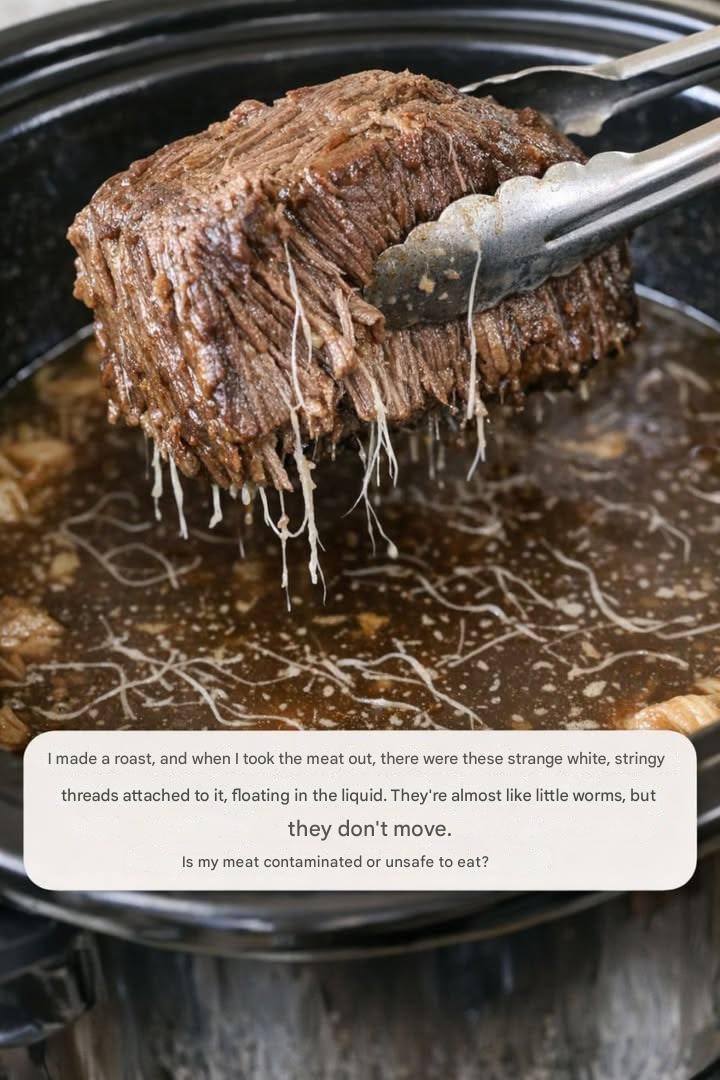
1. What are those white, stringy filaments in your roast?
The white, stringy strands you see are most likely collagen and connective tissue strands, natural components of meat. During cooking, collagen breaks down into gelatin, giving the tender texture typical of slow-cooked dishes. These strands may become more visible in the cooking liquid as they separate from the meat fibers.
They’re generally harmless and part of the normal cooking process. However, if they seem excessive or unusual, it’s worth examining them more closely to rule out other problems.
2. Collagen, connective tissue and why they become fibrous
Collagen is a protein found in the connective tissues of animals and is particularly abundant in tougher cuts of meat, such as beef neck or brisket. During slow cooking, collagen gradually breaks down into gelatin. This transformation gives the stew its rich, tender texture.
As collagen dissolves, it can form more visible stringy strands in the liquid. Cooking meat at a low temperature for a longer period, such as 3-4 hours at 163°C (325°F), helps break down these fibers more completely, reducing the stringy appearance.
3. How to distinguish collagen filaments from real worms or parasites
While the white threads are most likely collagen, it’s understandable to be concerned about parasites. Collagen threads are typically uniform in thickness and don’t move, while worms exhibit movement and irregular shapes.
When in doubt, inspect the meat carefully. Collagen softens and dissolves further with cooking, but parasites do not. Buying meat from reputable sources and cooking it to a safe internal temperature greatly reduces any risk.
4. Visual, textural, and odor cues that indicate the meat is still healthy
Use your senses to assess safety:
