
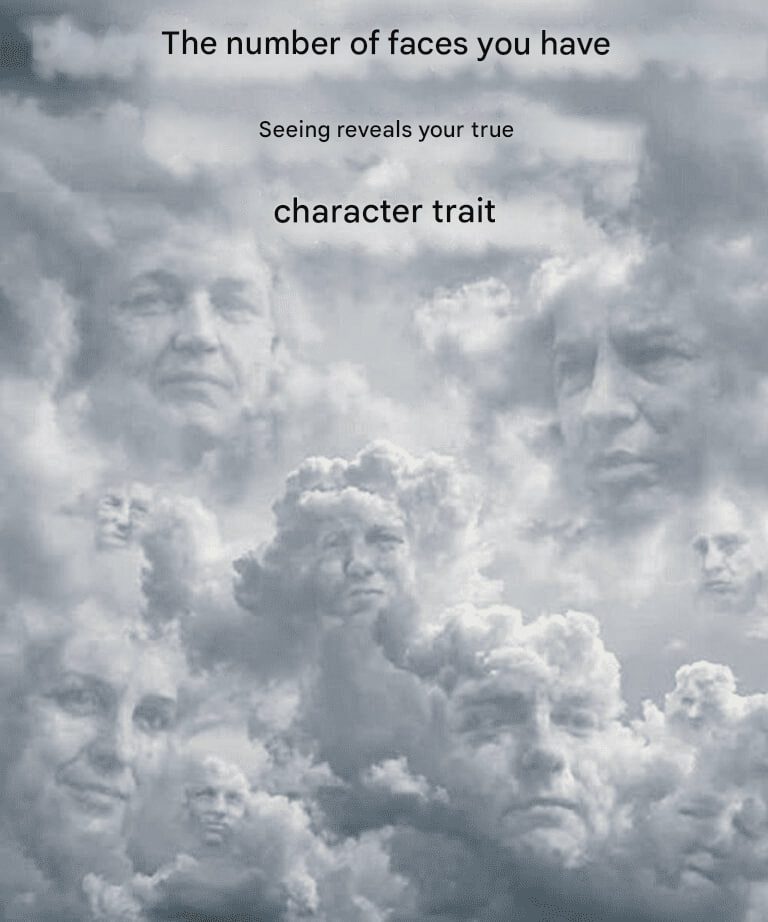
Optical illusions work because the human brain is constantly searching for meaning. It dislikes uncertainty. If information is incomplete or ambiguous, the brain intervenes and fills in the gaps using memories, emotions, and learned behavioral patterns.
Therefore, two people can look at the same picture and have completely different experiences. One might only see clouds, while the other immediately recognizes faces. Neither of these reactions is wrong. Each simply reflects a different way of perceiving the image.
Faces are of particular importance to the brain. From early childhood, we are programmed to quickly recognize faces. This ability helped our ancestors survive, as it allowed them to perceive people nearby. Over time, this instinct has become deeply ingrained in us.
Therefore, the brain often recognizes faces even when none have been intentionally placed there. In cloud formations, tree bark, or shadows on a wall, the brain searches for familiar patterns. The intensity of your reaction to these patterns can reveal how you perceive the world around you.
What does it mean to see one to three faces?
If you only noticed one to three faces, you probably have a focused and realistic mind. Your attention naturally draws to what is most obvious, rather than getting lost in every detail.
People with this perceptual style are often pragmatic and balanced. They value clarity over complexity and generally prefer to make decisions based on concrete facts. When faced with uncertainty, they tend to simplify rather than overanalyze.
